




Hello-FPGA-ZU19EG | Zynq UltraScale+ MPSoC Dev Board
● Memory: 10GB DDR4 (PS) + expandable DDR4 SODIMM (PL)
● 4 QSFP28 fiber ports | 25Gbps per lane, total 400Gbps bandwidth
● Use Cases: industrial inspection, medical endoscopy, semiconductor production, smart city surveillance
Hello-FPGA-ZU19EG | Zynq UltraScale+ MPSoC Development Board
High-performance Zynq UltraScale+ MPSoC Platform - Dedicated to High-speed Data Exchange, Video Acquisition & Processing
Documents Download
Hello-FPGA-ZU19EG Zynq UltraScale+ MPSoC Development Board User Manual.pdf
ZU19EG-FMC-CXP-4R CoaXPress Frame Grabber User Manual.pdf
Detailed Specifications

Product Photos
Four Core Advantages
Powerful Programmable Logic Resources
Adopts Xilinx ZU19EG chip with PS (Processing System) + PL (Programmable Logic) co-architecture. It integrates CPU general computing, FPGA hardware acceleration and GPU AI inference. Equipped with Quad-core Cortex-A53 + Dual-core Cortex-R5 processors, it meets the requirements of complex algorithms and high-speed data processing.
Multi-protocol High-speed Interconnection
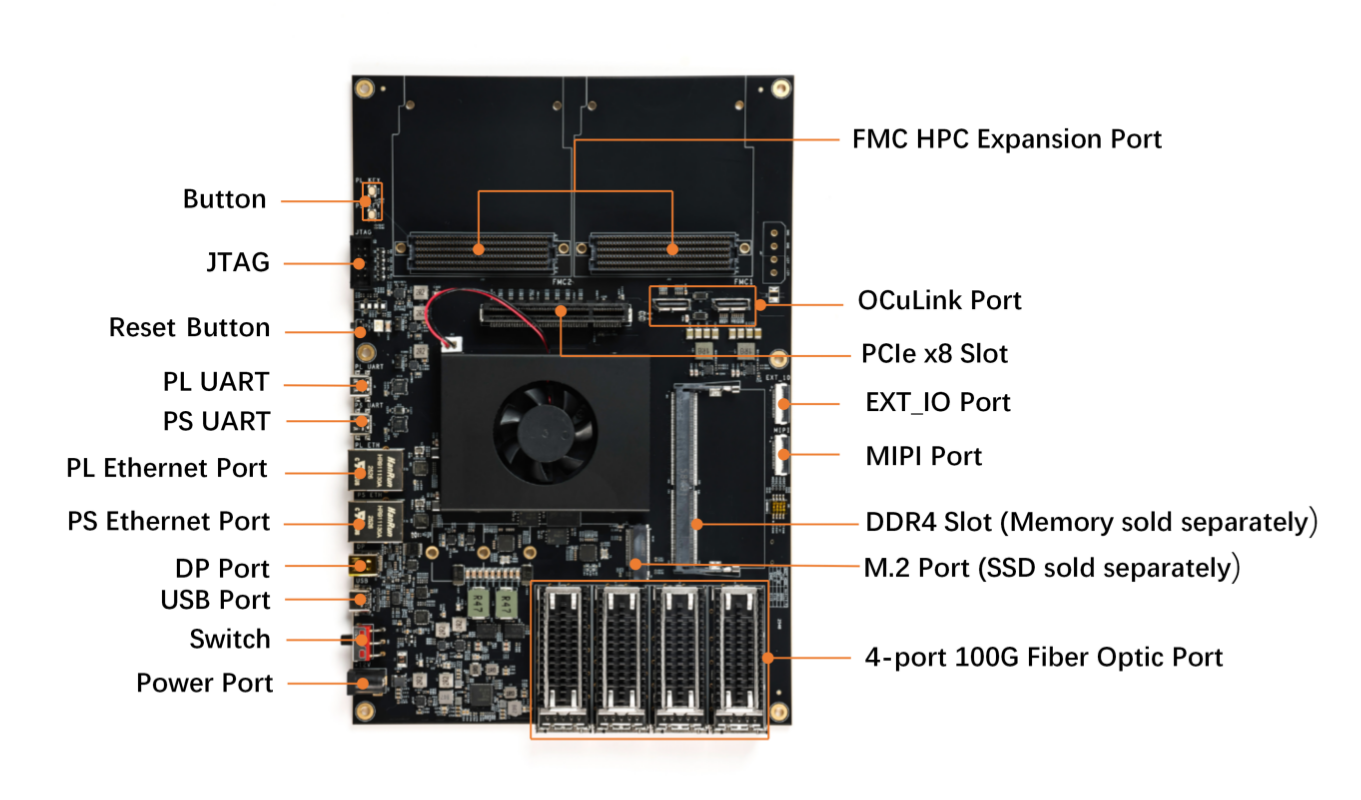
Supports high-speed SD/MIPI/QSFP 100G X4 / FMC HPC X2 interconnection. Built-in 4 QSFP28 fiber interfaces (total bandwidth up to 100Gbps) and PCIe 2.0 x8 interface, suitable for various high-speed peripherals and data transmission scenarios.
Flexible Hardware Expansion
Comes with 2 dual-width FMC interfaces, 1 M.2 SSD interface, 2 OCUlink interfaces, mini-DP display port, USB 3.0 and Gigabit Ethernet. It can connect HDMI modules, camera modules, high-speed AD modules and more for diverse application scenarios.
Large-capacity Onboard Storage
PS side is equipped with 5 × 2GB DDR4 SDRAM (10GB total). PL side has a 260-pin DDR4 SODIMM slot. Onboard 32GB eMMC FLASH + 2 × 512Mb QSPI FLASH, fully meeting the demands of system operation, file storage and data caching.
Product Overview
The Hello-FPGA-ZU19EG is a professional ZYNQ development platform, designed for high-speed data exchange, data storage, video transmission & processing, deep learning, AI and industrial control. It adopts 18-layer industrial-grade PCB design and works stably within a wide temperature range from -40℃ to +100℃.
Powered by Xilinx ZU19EG-2FFVC1760I, it realizes efficient combination of general computing and hardware acceleration via PS & PL co-architecture. Onboard temperature & humidity sensor, RTC real-time clock, LED indicators and user buttons facilitate development, debugging and status monitoring.
Complete toolchains and algorithm support are provided. It is widely used in industrial inspection, medical endoscope, semiconductor manufacturing, smart city security and other fields. We also provide customized FPGA solutions, FPGA localization services, FPGA SOM core boards and development kits.
Key Features
- Main Chip: Xilinx ZU19EG-2FFVC1760I (ARM+FPGA heterogeneous architecture)
- Processor: Quad-core Cortex-A53 + Dual-core Cortex-R5 with GPU for AI inference
- Storage: 10GB DDR4 (PS side) + Expandable DDR4 SODIMM (PL side), 32GB eMMC + 2×512Mb QSPI FLASH
- High-speed Interfaces: 4 QSFP28 fiber interfaces (25Gbps per channel, 100Gbps total), PCIe 2.0 x8 host slot
- Display Interface: 1 × mini-DP, supports 4K@30Hz or 1080P@60Hz video output
- Expansion Interfaces: 2 × FMC HPC, 1 × M.2 SSD, 2 × OCUlink, 2-Lane MIPI camera interface
- General Interfaces: USB 3.0 TYPE-C, 2 × Gigabit Ethernet, 2 × UART to USB
- Operating Temperature: -40℃ ~ +100℃, industrial-grade reliability
- Auxiliary Functions: LM75 temperature & humidity sensor, 24LC04 EEPROM, RTC, 4 dual-color LEDs, 3 user buttons
Technical Specifications
| Item | Specification |
|---|---|
| Main Chip | Xilinx Zynq UltraScale+ XCZU19EG-2FFVC1760I |
| Processor Architecture | Quad-core Cortex-A53 + Dual-core Cortex-R5 + GPU (AI Inference) |
| Onboard Memory | PS: 5×2GB DDR4 SDRAM (10GB Total); PL: 260-pin DDR4 SODIMM Slot (Memory sold separately) |
| Storage | 32GB eMMC FLASH; 2×512Mb QSPI FLASH |
| Fiber Interfaces | 4 × QSFP28, 25Gbps per channel, 100m transmission over OM4 multimode fiber, 100Gbps total bandwidth |
| PCIe Interface | 1 × PCIe 2.0 x8 Host Slot, compatible with x8/x4/x2/x1 cards |
| Display Interface | 1 × mini-DP, 4K@30Hz / 1080P@60Hz Output |
| Expansion Interfaces | 2 × Dual-width FMC HPC; 1 × M.2 SSD; 2 × OCUlink; 2-Lane MIPI Camera Interface |
| General Interfaces | 1 × USB 3.0 TYPE-C; 2 × Gigabit Ethernet (RJ45); 2 × UART to USB (CP2102-GM); 1 × Micro SD Card Slot |
| Power Input | +12V DC, Max 5A with over-current protection |
| Logic Cells | 1143K |
| Flip-Flops | 1045K |
| LUTs | 523K |
| Block RAM | 34.6Mb |
| CMTs | 11 |
| DSP Slices | 1968 |
| GTH 16.3Gb/s Transceivers | 44 |
| Operating Temperature | -40℃ ~ +100℃ |
| PCB Design | 18-Layer Industrial-grade PCB |
Interface Layout Diagram
Mechanical Dimensions
Power Specifications & Packing List
| Power Specifications | Requirements |
|---|---|
| Input Voltage | +12V DC |
| Input Current | Max 5A, with over-current protection |
| Power Supply | Use dedicated 12V/5A power adapter |
| Packing List | Quantity |
|---|---|
| Hello-FPGA-ZU19EG Development Board | 1 Piece |
| Cooling Fan | 1 Piece |
| 12V/5A Power Adapter | 1 Piece |
| TF Card (Pre-installed System Image) | 1 Piece |
| USB Programmer | 1 Set |
| Protective Enclosure | 1 Piece |
Safety Warnings (Must Read)
- Do not plug or unplug the board or external modules while powered on, to avoid short circuit or static damage to chips.
- Please take ESD protection (e.g. wear anti-static wrist strap) before touching the board to prevent static breakdown of precision components.
- Only use the original 12V/5A power adapter. Do not use mismatched or poor-quality power supplies to avoid board burnout.
- Confirm pin definition before connecting peripherals, prevent reverse polarity or signal conflict leading to hardware damage.
- Use in dry, dust-free, low-vibration and anti-EMI environment. Avoid long-term operation under high temperature, high humidity or strong magnetic field.
- The board generates heat during operation. Ensure the cooling fan works properly; do not run under heavy load without heat dissipation.
Quick Start Guide
- Check the packing list to confirm all items are complete and undamaged.
- Install the cooling fan and insert the TF card with pre-installed system image.
- Connect the 12V/5A power adapter and check if the power indicator lights up normally.
- Connect the board to PC via USB programmer, install drivers and Xilinx toolchains such as Vivado.
- Download test programs via JTAG or boot the system from TF card to verify basic functions.
- Connect external modules (camera, FMC expansion board, etc.) as required, refer to user manual for configuration and programming.
Typical Applications

Semiconductor Inspection
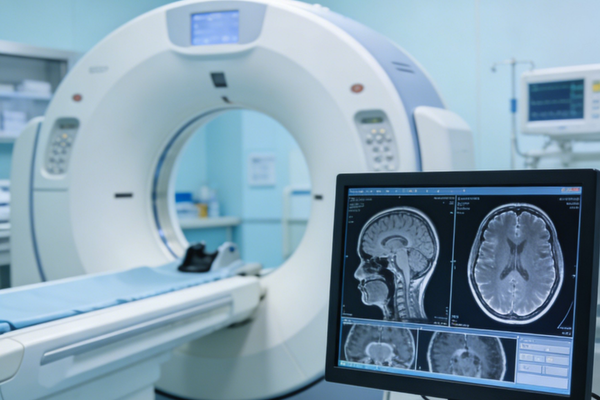
Medical Imaging

Aerospace

Industrial Automation

Machine Vision

Precision Inspection

