

Can CoaXPress 2.0 Cameras Work with CoaXPress 1.1 Frame Grabbers?
Can CoaXPress 2.0 Cameras Work with CoaXPress 1.1 Frame Grabbers?
Yes
The short answer is yes.
There are two major CoaXPress standard versions:
CoaXPress 1.1 released in 2011
CoaXPress 2.1 released in 2021, which maintains backward compatibility. The revised standard adds synchronization functions and doubles the data transmission rate.
CoaXPress 2.1 is fully forward-compatible with CoaXPress 1.1 as long as both sides comply with the CoaXPress standard and the connectors match.
Key conclusions are summarized below (reference article: What Should I Know About CoaXPress 2.0?):
- 1. All cameras and frame grabbers will initialize at CoaXPress 1.1 mode. CoaXPress 2.0 mode will only be activated when both the frame grabber and the camera support CoaXPress 2.0.
- 2. CoaXPress 2.0 delivers up to 12.5 Gbit/s bandwidth, known as the CXP12 rate grade.
- 3. CoaXPress 2.0 supports the new micro BNC connector.
- 4. CoaXPress 2.0 supports multi-host streaming: one camera can output data to multiple frame grabbers installed on different PCs to realize parallel computing.
- 5. CoaXPress 2.0 implements GenICam features including heartbeat synchronization, event notification and hardware timestamps that are actively pushed from camera to grabber.
- 6. CoaXPress 2.0 raises the upstream control bandwidth under CXP10 / CXP12 speed grades.

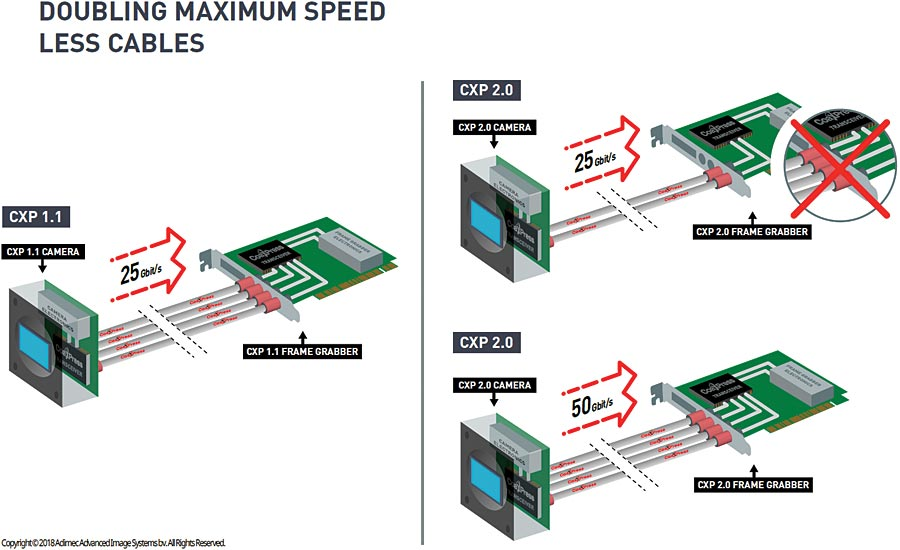
1. CoaXPress 2.0 is Compatible with CoaXPress 1.1
All cameras and frame grabbers boot up in CoaXPress 1.1 mode. The system will only switch to CoaXPress 2.0 mode if both hardware sides support the newer standard.
This means CoaXPress 1.1 cameras work with both CoaXPress 1.1 and CoaXPress 2.0 frame grabbers. Similarly, a CoaXPress 2.0 camera can run on a CoaXPress 1.1 frame grabber, but all CoaXPress 2.0 exclusive features will be disabled.
2. Doubled Maximum Bandwidth
The most prominent improvement is the data rate upgrade. CoaXPress 2.0 reaches 12.5 Gbit/s (named CXP12). After accounting for transmission overhead, the effective payload bandwidth reaches roughly 9.6 Gbit/s.
For example, with a 5120×5120 10-bit sensor: 4-lane CoaXPress 2.0 at CXP12 can achieve approximately 146 FPS. By contrast, 4-lane CoaXPress 1.1 at CXP6 only reaches 73 FPS.
Hardware note: CoaXPress 1.1 works fine with PCIe Gen2 x8 or PCIe Gen3 x4 slots for most projects. CoaXPress 2.0 requires PCIe Gen3 x8 or higher as the minimum host bus.
3. New Micro BNC Connector
CoaXPress originally adopted standard BNC connectors, then shifted to smaller DIN 1.0/2.3 connectors. However, DIN connectors received widespread complaints and cannot carry the high-frequency CXP12 signal.
The newly defined micro BNC solves these problems. It keeps the compact size of DIN connectors while maintaining the mechanical stability of standard BNC. Micro BNC fully supports CXP12 high-frequency signals and allows dense pin layout. It is already a mature standard widely used in broadcast video equipment. Although slightly more costly than DIN connectors, micro BNC guarantees stable transmission under 12.5Gbps CXP2.0 speeds.
4. Video Streaming to Multiple Host PCs
Image processing on a single PC often becomes the performance bottleneck. CoaXPress 2.0 adds an optional multi-host streaming function: one camera can feed data to multiple frame grabbers on separate computers for parallel calculation.
Two typical working modes:
1. Duplicated full frame broadcast
A camera with four CoaXPress ports connects to four different frame grabbers on four PCs. The full complete image is copied and sent to every host simultaneously.
2. Image split & distributed transmission
The camera divides one frame into several horizontal or vertical strips, then sends each segment to an independent PC for parallel processing.
Note: This is an optional extension of the standard. Please confirm supported configurations with your camera and frame grabber vendor.
5. Heartbeat, Events and Hardware Timestamps
Heartbeat, event trigger and timestamp are classic GenICam functions missing in CoaXPress 1.1. CoaXPress 2.0 fully enables these functions.
Heartbeat
The heartbeat message realizes multi-camera synchronization. Every camera runs on its own local clock. The frame grabber calculates the precise camera time via periodic heartbeat packets and aligns it with the host clock. The grabber can further synchronize its clock with IEEE 1588 PTP time servers. With heartbeat synchronization, users can compare the precise time of events captured by different cameras across multiple frame grabbers.
Events & Timestamps
The camera actively pushes event messages together with accurate timestamps to the frame grabber without polling. Typical events include exposure start/stop and over-temperature alarm. The timestamp is calibrated based on the heartbeat clock, so the host knows the exact moment when the event occurs.
6. Lower Trigger Latency
CoaXPress 2.0 raises the upstream control bandwidth under CXP10 and CXP12 speed grades (CXP6 and lower lanes still follow CoaXPress 1.1 upstream rate). The upgraded uplink cuts trigger round-trip latency in half.
The latency is defined as the time interval from trigger signal transmission to the moment the camera receives the trigger and starts exposure. The latency drops from 3.4 µs (CXP1.1) down to 1.7 µs (CXP2.0).

